Thursday, February 28, 2013
Child of Europe
There can be no question of force triumphant
We live in the age of victorious justice.
Do not mention force, or you will be accused
Of upholding fallen doctrines in secret.
He who has power, has it by historical logic.
Respectfully bow to that logic.
Let your lips, proposing a hypothesis
Not know about the hand faking the experiment.
Let your hand, faking the experiment
Not know about the lips proposing a hypothesis.
Learn to predict a fire with unerring precision
Then burn the house down to fulfill the prediction.
— Czeslaw Milosz

Wednesday, February 27, 2013
Got My Black Belt in 'Bloated Bureacracy'

Seems like the larger a company gets and/or the more involved with federal regulations it gets, the more that company buys into certain ideas:
- The cure for anything is a regulation, a new process rule, or a new standard. The problem isn't that people aren't thinking for themselves; the problem is that they are doing entirely too much thinking for themselves.
- The key to competitiveness is really optimization, not innovation. That's why it's important to reward and recognize (and build whole hierarchies for) for optimizing (or really, the gesture of optimizing).
- Better to automate "employee development" as much as possible. Personal mentorship is overrated, and only works if you actually encourage leadership anyway.
- We can replace actual leadership with aphorisms about leadership.
- We can replace actual accountability with slogans about accountability.
- You can promote ethical behavior by coercing employees to sign documents averring they intend to behave ethically.
Et cetera.
One of the effects on engineering (assuming that a big company has such a division) is that a company will expect their engineers to feel empowered to control his process [don't be dismayed is this sounds like gibberish--it is gibberish] while choosing their tools for them, both intellectual tools and instrumental tools.
The "leadership" in big companies tend to see nothing wrong with this. (Until recently, Google may have been an exception.) They absolutely don't see where the conflict lies. Big corporations nowadays tend to appoint short-sighted optimization junkies (i.e. lean process black belts [more gibberish]) out of the manufacturing area. You see, in engineering we work with ideas and, so the story goes, don't actually make anything.
What good are ideas anyway?

Tuesday, February 26, 2013
Black Dahlia Avenger

I've been reading Black Dahlia Avenger and it's quite a page-turner.
I'll try not to give anything away, even though the identity of the killer is not something you find out at the end of the book. Far from. But that's not the most important revelation.
 It is a "Columbo mystery" in case you are a mystery. More of a howdunnit than a whodunnit. But more of a whydunnit than a howdunnit, really. As in the Colombo mysteries, the real mystery is how the truth will eventually come to light. And a whoelsewasitdunnit-to. And a whywuzzinitsolved. (That aspect might be especially scary.)
But even beyond that, the way the investigative material comes together with the personal remembrances of the author are amazing.
Steve Hodel paints a picture of a place on the Gold Coast where intellectual elite, the entertainment elite, the artistic elite, and the elite of corruption and hedonism all converged on a certain home in L.A. The personal remembrances touch upon several celebrities. Doesn't come across as namedropping but a revelation of how, in Southern California, people-who-know-people actually tend to, well, know people. The sordidness of the scene will revolt you, as artists purport to transcend morality by indulging a mix of egotism, vengeance, and thrill-seeking as they send their message to scoety that they are free of traditional morality.
It's an investigative odyssey. One I recommend.
Saturday, February 23, 2013
Shampoo ain't netchural
Washing hair with shampoo is not a natural act it would seem. How long has humanity had soap and chandlers, let alone hair soap? Shampoo is just soap modified specifically for hair.
Given this, why does it feel so unnatural for me to go without washing my hair? I can't stand the way my head feels after a day without washing. It's grimy and itchy. I hate it.
Saturday, November 17, 2012
Politics, Science, and Religion
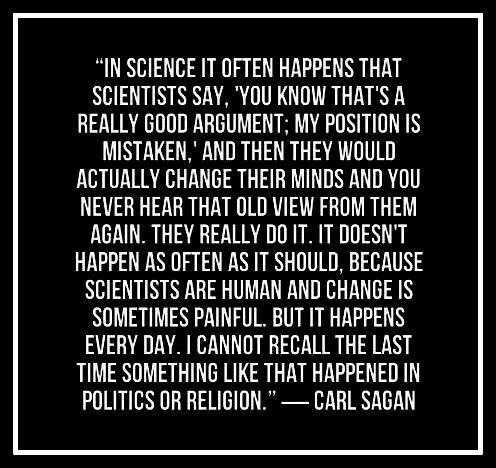 |
| Does this reflect reality, or just Carl Sagan's little corner of it? It doesn't reflect my reality. |
Anyway, that is neither here nor there...
What is the difference between religion, science, and politics? The difference, as I see it, is that politics gets down to the nitty-gritty of policy.
Everything is political in the general sense that life is about negotiation--if you are not a hermit and other people are involved in your life at all. Your obligations will be negotiated with others' obligations to you. So relationships are political in a certain sense because there is an interplay of power. A conscious or unconscious choice to be withdrawn, to burst into tears, to be sullen or snarky, or to be conciliatory, all involve how it negotiates your place in the relationship. Maybe it places you ahead, maybe it attempts to share power, maybe it means to put yourself down (because you feel that's what you deserve).
People don't like this because it sounds like everything is a Macchiavellian pursuit of power--those that think this are likely to think that everything that occurs in the expressly political field of Public Policy and Government Policy are merely power plays. Which is sad. Because people like this don't realize the genius behind the founding documents of America and have a cynical view of these documents, while likely thinking themselves to be very sunny and optimistic (and maybe apolitical people). I think the more reasoned view is realizing that every act involving other human beings potentially affects your relationship with them, changes the nature of how you interrelate. This is realism.
Science and religion: These are two kinds of endeavors that both purport to convey truth. In some ways, in America, science is more thickly intertwined with public policy (what we think of as "politics") because it is often directly supported with public funds. Religion is intertwined with politics more in the sense of people's private sense of morality directing them to choose policies that they feel best mold/preserve society, and by private sense of morality, I don't just mean those moralities directed by a traditional, deity-centered religion. And the more government is involved in people's lives, and the more centralized that government involvement is, the more you will find people treating their views on politics (and science) with a kind of religious intensity, because views on these matters directly affect their way of life, their culture, the cultural atmosphere their children are raised in.
On a less grand level, I think in any human institution, whether religion or science, humans play their little political games to define the agenda, how the institution's resources (financial or human) are used, etc. There are always competing visions. People are more willing to give on minor issues (and therefore see the other person's point of view); less so on more fundamental matters. If you've spent decades on an avenue of research or built your work on some theory (or research program, as one philosopher put it), chances are you are not going to abandon it just because someone provides a "knockdown argument." If you are invested even a little in anything (and being human, you probably are), you will be a little dubious about someone else's "facts" (even if published), inferences, or methodology. Your intuition will be that the knockdown argument isn't really knockdown. If "facts" or tenets are established authoritatively, the authority that establishes it is itself a power structure, whether or not it is recognized as such.
Subscribe to:
Posts (Atom)